Corrective Trimming for Angular Limb Deformity (ALD) in the Horse.
Successfully addressing angular limb deformities entails accelerating growth along the short side of the bone and/or decelerating growth along the long side of the bone. The difference in growth rate between treated and untreated sides of the bone results in overall straightening of the limb.
The farrier correctively trims ALD foals with the following goals in mind:
-
To reposition the foot back under the limb in a valgus setting. This is accomplished via trimming of the lateral (outside) half of the wall relative to the inside half.
-
To reposition the foot back under the limb in a varus setting. This is accomplished via trimming of the medial (inside) half of the wall relative to the outside half.
-
To reestablish normal foot balance in a valgus setting. In many cases of valgus angulation, the inside wall is shorter than the outside wall. This results in a "tilting" of the coronet band and outward rotation of the foot. Trimming lateral toe-quarter and medial heel quarter is often performed to reestablish normal foot balance in this scenario.
-
To reestablish normal foot balance in a varus setting. In many cases of varus angulation, the outside wall is shorter than the inside wall. This results in a "tilting" of the coronet band and inward rotation of the foot. Trimming medial toe-quarter and lateral heel quarter is often performed to reestablish normal foot balance in this scenario.
When trimming alone is not sufficient, your farrier may also apply extensions to amplify the effect of corrective trimming and further stimulate correction of the angular deformity. Extensions are generally comprised of polymethylmethacrylate glue (PMMA or Equilox®), corrective shoes or a combination of both.
In many cases, angular deformities can be successfully addressed by the farrier alone (with no veterinary assistance). Since bone growth is manipulated to produce the desired effect, it is best to implement corrective measures when the foal is relatively young (less than 6 months of age) and has still has plenty of growing to do.
We will now take you through the process of correctively trimming a foal with carpal valgus angular deformation.

The foot is trimmed as described above. In the case of the carpal valgus angulation, the lateral (or outside) aspect of the foot is trimmed relative to the inside aspect of the foot.

Once correctively trimmed, the foot is rasped to created a flat surface upon which the foal will walk.

The sole and wall of the side of the foot upon which the extension will be applied is sanded to create a clean/ rough surface. In the case of the carpal valgus angulation, the medial (or inside) aspect of the foot is sanded.

Polymethylmethacrylate glue (PMMA or Equilox®) is prepared by mixing the adhesive resin and accelerator components.

Once thoroughly mixed, the adhesive is applied to the wall and sole of the "short side" of the foot. In the case of the carpal valgus angulation, the adhesive is applied to the medial aspect of the foot.
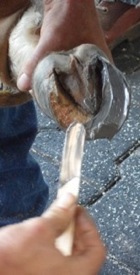 
The adhesive is smoothed to create a flat solar surface.
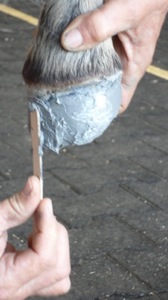 
The adhesive is extended to encompass the wall on the appropriate side of the foot (in this case the medial wall).
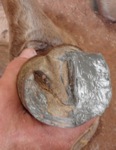 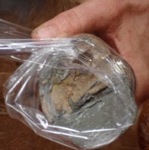 
Saran® wrap is applied over the prothesis to prevent cracking and deformation during the curing process, which takes about 6-8 minutes. Since curing occurs via an exothermic reaction between the adhesive and accelerator (which generates heat), sedation of the foal is often helpful in preventing excessive movement during this phase of the process.

Once the adhesive has hardened to some degree, the foot can be placed on the ground until the curing process is complete.

The Saran® wrap is removed after the adhesive has fully cured (6-8 minutes).
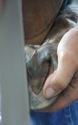 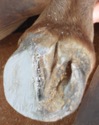 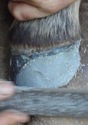 
The adhesive is rasped to create flat smooth surfaces along the sole and wall of the foot.
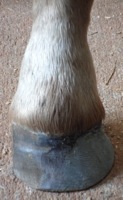 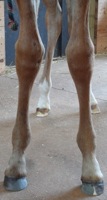 
An obvious change in the orientation of the foot relative to the limb is observed following corrective trimming and extension application. In the case of the carpal valgus angulation, the foot will appear to "turn and tilt inwardly" relative to the limb's axis.
This change in foot angle/ position will encourage accelerated growth along the lateral (outside) aspect of the radius and decelerated growth along the medial (inside) aspect of the radius, thereby promoting straightening of the foal's distal limb.
|