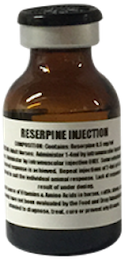
Reserpine is a naturally-occurring tranquilizer that has been used for centuries in India. The drug is extracted from the root of the Indian Snakeroot (Rauvolfia serpentina) and Poison Devil’s Pepper (Rauvolfia vomitoria) plants which are found in both India and Africa. The purified alkaloid of these plants (known as reserpine) was first isolated in 1952 and is considered to be the first modern drug to treat hypertension in humans.
Reserpine irreversibly binds to the storage vesicles of neurotransmitters, most importantly norepinephrine, serotonin and dopamine. The body's resulting inability to store these neurotransmitters eventually causes catecholamine depletion which in turn produces tranquilizing effects.
The drug may take hours or days to reach its full effect and may last for up to multiple days or weeks. It’s long-lasting effects make it a popular choice for use in horses confined to a stall for prolonged periods. Click HERE to review another way of keeping your horse quiet during confinement.
Side Effects of Reserpine
Positive and negative effects can vary greatly between horses; some animals appear to be especially sensitive to reserpine. Possible side effects include:
- Colic
- Gastrointestinal upset
- Diarrhea
- Excessive sweating
Of these, mild diarrhea is the most commonly-observed. We ask our clients to contact us immediately if fecal softening becomes evident. In most cases, associated diarrhea can be treated successfully by lowering the dose of the drug.
Due to the nature and long-lasting effects of reserpine, we discourage our clients from using other sedatives (such as Xylazine, Sedivet or Dormosedan) for 3-4 weeks following its administration. Horses treated with reserpine within this time-frame should also not undergo general anesthesia for elective procedures.
Reserpine may also increase an animal’s predisposition to gastric ulceration via increased acid secretion from the stomach’s lining. You can review the clinical signs associated with equine gastric ulcer syndrome (EGUS) HERE.
Transient or permanent penile paralysis in stallions (a condition known as “paraphimosis”) is another possible (but rare) side effect of reserpine administration.
Reserpine Use During Competition
Reserpine is prohibited for use during most sanctioned events and has historically been the source of a number of drug violations due to its long and variable withdrawal period. Recent improvements in detection sensitivity and accuracy have all but eliminated reserpine use in competition.
Interestingly, blood testing for this drug is sometimes complicated by the inadvertent detection of related herbs and plants commonly found in supplements, pastures and hay, which also can also produce a positive result.
The recommended FEI withdrawal period is 90 days (regardless of route of administration).
Reserpine Dosing
Reserpine can be administered intramuscularly or orally. Please click HERE to review our recommended intramuscular injection sites for the horse.
Oral Dosing
The initial dose for an adult horse is generally 2-5 mg per day. After 5 days the dose can be increased or decreased depending on the horse’s initial response. It is important to allow at least 3-5 days for the drug to reach peak effect prior to each dose adjustment.
The MAXIMUM daily dose of oral reserpine should not exceed 10mg for a 1000- to 1200-lb horse. If this dose does not produce the desired affect then reserpine administration should be discontinued and another strategy utilized. Please consult your veterinarian with regard to other options. Several alternate methods are listed HERE.
In many cases, the dose can be tapered after 2 weeks of therapy and still maintain a comparable effect. We encourage our clients to use the lowest dose possible to produce the desired effect.
As mentioned above, soft feces or diarrhea can be an occasional side effect of daily reserpine administration. In this case, we recommend decreasing and/or splitting the daily dose until the problem resolves.
Intramuscular Dosing
Please consult your veterinarian directly regarding intramuscular administration of reserpine.
In most cases, a 5- to 7.5-mg dose is administered once every 3 to 4 weeks as needed. Supplemental doses can be administered if the horse’s initial response proves to be inadequate.
Methamphetamine can be used as an antidote in cases of reserpine overdose (which is a relatively rare occurrence).
|