 |
 |
 |


SYSTEMIC ARTHROTHERAPY

Joint supplements have seen wide use in recent years, and are most often the horse owner's first line of treatment for equine arthritis. The primary goal of the joint supplement is to stimulate normal activity and function of the synovial membrane thereby enhancing the integrity of the joint environment. Topical, oral, intravenous, and intramuscular forms exist.
Any medication administered outside the joint (by mouth, intravenously, or intramuscularly for example) for the purpose of improving joint function and/or comfort is considered a form of systemic arthrotherapy. Anti-inflammatory medications (such as phenylbutazone and Banamine), topical pain relievers (such as capsaicin and diclofenac), and joint supplements (such as Adequan®, Legend®, and Cosequin®)are included in this category.

I. NON-STEROIDAL ANTIINFLAMMATORY MEDICATIONS
Non-steroidal antiinflammatory drugs (NSAIDs) such as Bute, Banamine, Ketofen, etc.) are frequently used to alleviate the clinical signs (namely inflammation and pain) associated with arthritis in horses. However, consistent use can result in gastric ulceration as well as kidney and liver dysfunction. Therefore, we recommend this form of therapy only for horses that perform very infrequently, such as once or twice weekly (or less).
Firocoxib is a NSAID that has been shown to reduce inflammation and pain associated with osteoarthritis in horses. At the same time, it offers a much better safety profile when compared to other (more traditional) NSAIDs. Equioxx® is the first coxib class nonsteroidal antiinflammatory drug that is highly selective against Cyclooxygenase-2 (Cox-2) prostaglandins which are responsible for inflammation. Unlike other NSAIDs, however, Equioxx® spares the beneficial Cox-1 prostaglandins required for normal gastric, renal (kidney), and hepatic (liver) function. A single dose lasts for 24 hours and can be administered for up to 14 days in a row.

Surpass® (diclofenac sodium) is a topical medication that has gained popularity due to its ease of administration (simply rub it on the affected joint) and its effectiveness for certain types of arthritis in horses. In our experience, Surpass generally works better under the following circumstances:
• In higher-motion joints. For example, we would expect a better response when treating a fetlock joint (which is very high-motion in nature) than we would when treating the lower hock joints (which are very low-motion in nature).
• In joints that are closer to the skin surface. If there is less tissue through which the product is required to diffuse then more will be delivered to the affected area. Consequently, we would anticipate a better clinical response if more product is reaching the joint. For example, we would expect a better response when treating a fetlock joint (which is just under the skin surface) than we would a stifle joint (which is much further/ deeper from the skin surface).
• In joints with a high topical surface area:size ratio. We typically observe a higher concentration of therapeutic medication in synovial (joint) tissue (and therefore a better clinical response) when the joint is smaller and very well exposed under the skin surface. For example, we would expect a better response when treating a fetlock joint (small and just under the skin surface) than we would a stifle joint (large and deep under the skin surface).
• When used prophylactically (as a preventative) rather than subsequent to the onset of joint inflammation. In other words, we would expect a better response if we applied the product prior to exercising the horse than we would if we applied the product after we finished riding.
II. ORAL MEDICATIONS
Most studies show that the oral medications (e.g. Cosequin®, MSM, Flex Free®, Corta-flex®, etc.) are quite effective when absorbed into the system. This type of arthrotherapy works especially well in people and dogs, who are able to absorb relatively large molecules (like glucosamine and chondroitin sulfate) through their intestinal wall easily. Horses, on the other hand, are generally not proficient at absorbing large molecules into their system from the intestinal tract. Therefore, a portion of the oral medication (and the client's investment) may not be completely utilized. Many companies are continually working to find ways to improve absorbability of oral supplements in the horse.
III. INJECTABLE MEDICATIONS
Medications which bypass the intestinal tract of horses (and therefore do not rely on intestinal absorption) are generally preferred due to their respective molecular availabilities. These are injectable (i.e. given as a shot) and include both LONG-TERM (maintenance) and SHORT-TERM forms.
SHORT-TERM medications are administered intravenously (IV) and therefore typically have a greater positive effect on joints. In other words, we generally observe more improvement in the horse's comfort following administration of short-term therapy (such as Legend®) than we do following administration of long-term therapy (such as Adequan®). The positive effect of short-term therapy, however, is only about one-half as long as that of long-term therapy.
It is for this reason that we recommend short-term therapy and long-term therapy with different goals in mind.
We currently recommend LONG-TERM joint therapy in the following instances:
• In horses with no current evidence of joint disease. In this case, the purpose of the medication is to delay the onset of joint disease.
• In horses with mild joint disease. In this case, the purpose of the medication is to alleviate symptoms enough for the horse to perform well in his/her intended capacity.
• In horses with moderate to severe joint disease that have previously been treated with local therapy (i.e. injection). The purpose of the medication in this case is to prolong the effect of the injection and delay the recurrence of clinical signs.
Long-term/ maintenance medications include Adequan®, Acetylglucosamine, Ichon™, Chondroprotec®, Pentosan and Glucosamine (among others). Most treatment protocols involve one injection (approximately 5cc or 500mg) in the muscle once weekly for 4 consecutive weeks and then continuing administration once or twice monthly thereafter (indefinitely). Luitpold (the maker of Adequan®) suggests administering a dose of their product once every 4 days for 7 treatments and repeating this protocol bi-annually. Cost for these products may vary between $12 to $50 or more per dose.
Learn How to Properly Administer an Intramuscular (IM) Injection |
|
 |
Click HERE to watch the video tutorial. |
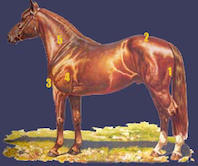 |
Click HERE to see our written recommendations. |
We currently recommend SHORT-TERM joint therapy 36-48 hours prior to a race, clinic, or show. The purpose of the medication is to maximize the performance of the horse for a selected event.
Short-term medications include Legend®, MAP-5, and Polyglycan® (among others). These medications are generally administered intravenously (in the vein) at varying doses. The cost of a single dose can range from $35 to $95.
If regular short-term treatment (i.e. an IV dose administered every 2-4 weeks or sooner) is required to produce and/or maintain soundness or does not result in a satisfactory response, then local arthrotherapy (i.e. joint injection) may be considered.
IV. BIPHOSPHONATES
Biphosphonates are a class of drug formulated to reestablish normal bone metabolism in pathologic conditions. They have a tremendous affinity for hydroxyappetite (a basic building block of bone) and work by inhibiting osteoclast-mediated bone resorption. This is accomplished by altering the metabolism of osteoclastic cells, thereby resulting in their death. Osteoblastic cells are then able to more effectively improve bone density and strength in an environment absent of osteoclastic activity.
In addition to hindering osteoclastic resorption of bone, biphosphonates may also function to dampen the response of chemical mediators involved in the process of inflammation. Both anti-inflammatory and analgesic (pain-relieving) properties have been suggested, although further research is needed to confirm this argument.
It should be noted that there are several explicit contraindications relating to the use of biphosphonates in horses. These should be reviewed carefully prior to considering this form of therapy for your horse.
At The Atlanta Equine Clinic, the use of biphosphonates has proved beneficial in cases of navicular inflammation, nonadaptive bone remodeling, and chronic severe osteoarthritis. TILDREN® (tiludronate) and OSPHOS® (clodronate) are two products frequently implemented in our practice.
Tildren® inhibits excessive bone resorption and promotes rebalancing of bone metabolism.
Osphos® is an injectable bisphosphonate solution which implements a similar mode-of-action as Tildren® by discouraging bone resorption by binding to calcium phosphate crystals (inhibiting their formation and dissolution) and by exerting direct cellular effects on osteoclasts. Unlike Tildren®, however, Osphos® has the unique advantage of intramuscular injection and is a ready-to-use solution that does not require mixing or reconstitution. It is also considerably less expensive than Tildren®.