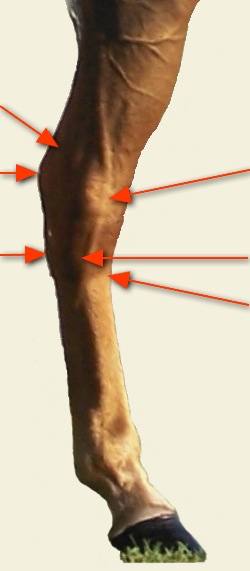
Hock Swellings
The tarsus (or "hock") is one of the most important structures with regard to soundness and performance. It is the primary weightbearing and propulsion joint of the equine hindlimb.

Most hock swellings are a result of inflammation within one or more structures that produce synovial fluid. Synovitis, tenosynovitis and bursitis are terms used to represent inflammatory conditions of joints, tendon sheaths and bursas, respectively.
Production of extra bone, such as in the case of “bone spavin”, can also result in localized enlargement of the hock. Bone is inflammation is termed osteitis.

It is important to note that the presence of hock swelling does not necessarily dictate that associated lameness will also be evident. In many cases, swelling of the hock is simply a cosmetic blemish and not a cause of pain. Nevertheless, most hock swellings can be unsightly and have the potential to develop into clinical problems if not successfully addressed. In general, the earlier treatment is implemented the better the chance of obtaining a permanent and satisfactory result.
Common hock swellings are identified based on their specific location with relation to the tarsal joints. The nature of the swelling (e.g. soft versus firm) can also help to isolate its source.
To learn more about specific hock swellings, choose a location below:
|